
About
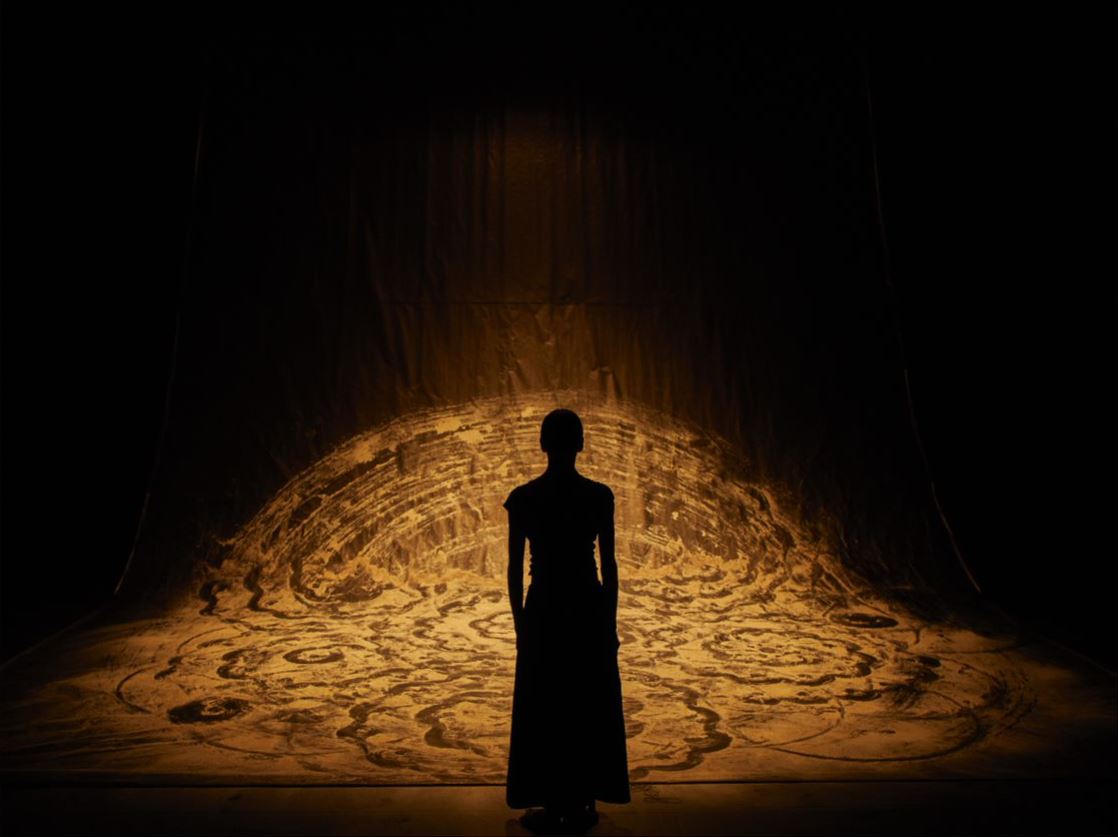
I met Shantala Shivalingappa in 2008, backstage at a theatre in Dusseldorf, where she was a guest of Pina Bausch. That's when it all came together in a really powerful way. aSH is the final opus in the trilogy of portraits of women started ten years earlier with Questcequetudeviens? (2008) and followed by Plexus (2012). In this trilogy, I do not take space as a starting point, which is my usual theme in theatre, but a woman, a person with a story, a living being who reveals herself through dance. Shiva, the god of dance, dwells in Shantala Shivalingappa. According to the texts, Shiva has over a thousand names. He is a god of creation and destruction. Ash is not merely the solid residue of perfect combustion, it is here a process. It is part of a cycle of birth and death that starts from nothing - the beginning of any form in the theatre - and leans towards an ephemeral form before it disappears. Shantala's dance resembles a kolam, a drawing made on the ground using flour in the morning, destroyed by the wind during the day and made again the next day. Circles, points, symmetries, spirals, fractals ... her dance seems to be a representation of the very structure of the world. In aSH, a title made up of her first and last initials, I would like the space to have a whole rhythm. I would like space to begin by expressing itself as a vibration, which is then picked up, transformed and extended indefinitely by percussionist Loïc Schild. Shantala's dance is based on her journey from India to Europe, from kuchipudi to Pina Bausch, from Shiva to Dionysus, god of theatre, who some say descended from the same god. Shantala is always traveling between Madras, where she was born, and Paris, where she lives. Her dance is a perpetual pendulum, much like our encounter: somewhere between the Hindu mystique and quantum physics. - Aurélien Bory
When
Sunday, 19 January 2020 17:30-18:30
Saturday, 18 January 2020 21:30-22:30
Gallery
-
PromoterTeatro Municipal do Porto
-
Target AudienceGeneral Public
-
Share This Page with others


-

Visit Porto
2020-01-07